
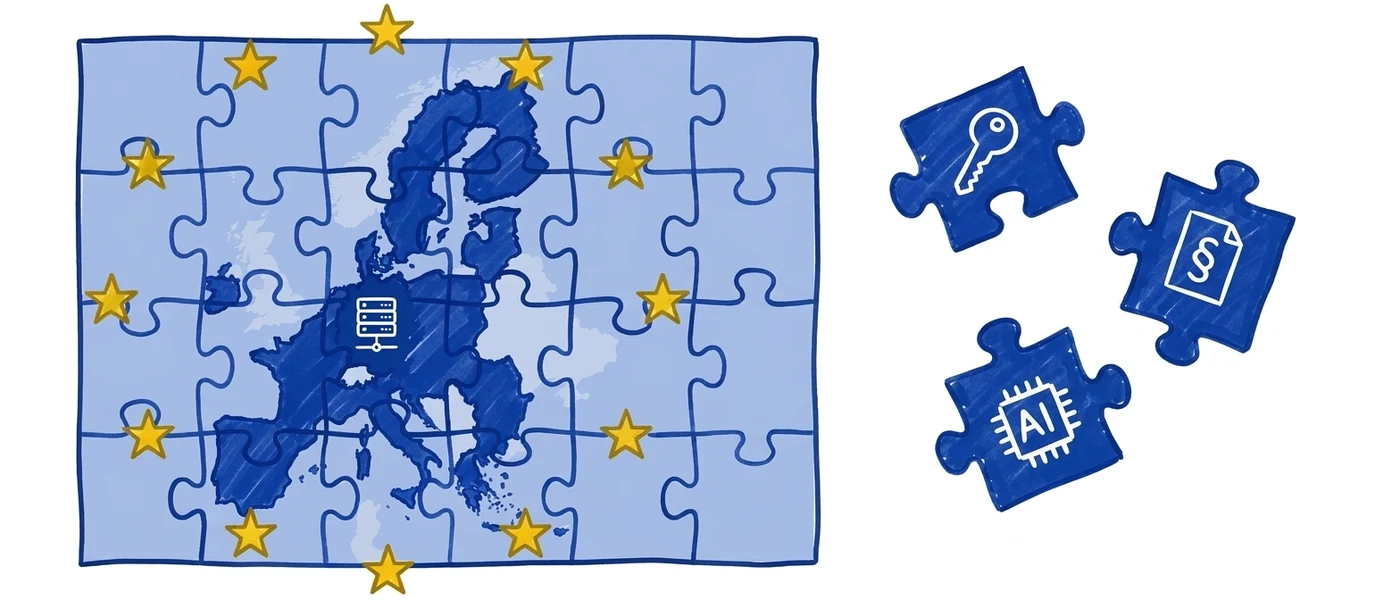
EU Hosting Isn't the Same as EU Compliance
EU cloud hosting does not guarantee GDPR or EU AI Act compliance. Learn how to map data flows, manage remote access, and meet your specific regulatory obligations.
Key Takeaways
- EU cloud hosting can reduce international-transfer exposure, but is not the same as an EU-only processing arrangement or on-premises installation.
- Remote access to personal data by a separate non-EEA service provider can trigger Chapter V of the GDPR (Transfers of personal data to third countries or international organisations) even when the database stays in Europe.
- Eliminating transfers does not remove GDPR duties concerning processing roles, contracts, security, accountability or lawful use of personal data.
- The EU AI Act requires a separate assessment of the AI system and the company’s regulatory role, not an assessment based on server location alone.
A common answer from non-EU SaaS and AI vendors preparing to serve European customers is straightforward: “We use AWS Frankfurt, so our data is hosted in the EU.” The architecture may be sensible. It can reduce operational costs, simplify certain security arrangements and avoid some transfers of personal data to countries outside the European Economic Area (EEA). But the statement does not, by itself, establish GDPR or EU AI Act compliance.
The critical distinction is between where infrastructure is located, who can access the data, and which regulatory duties attach to the product and its provider. An EU-hosted application may still rely on support teams, AI APIs or subcontractors abroad. And even genuinely EU-only processing leaves other legal obligations intact.
1. What local deployment actually solves
“Local deployment” is frequently used as a broad commercial description rather than a precise technical term. EU cloud hosting means an application runs in an EU cloud region, such as AWS Frankfurt. EU-only processing describes a more demanding architecture in which relevant data storage, model inference, backups and access are confined to the EU/EEA, subject to verified technical and organisational restrictions. On-premises deployment usually means that software is installed on infrastructure at the customer’s own site or within an environment the customer directly controls. These arrangements are not interchangeable.
For a small B2B software supplier, renting EU cloud infrastructure is often more proportionate than building or maintaining an independent European data centre. It may help meet contractual data-residency requirements, improve latency and support security controls. Importantly, it can make certain third-country data transfers unnecessary. Yet selecting an EU region for a database does not automatically govern the location of backups, monitoring records, inference requests, disaster-recovery services or technical support.
Cloud outsourcing also does not move all security responsibilities to the cloud vendor. AWS describes security and compliance as a shared responsibility: it operates and secures the underlying cloud infrastructure, while the customer remains responsible for relevant application, data and configuration measures, depending on the service used.
An initial compliance check should therefore begin with an architecture and data-flow map, not with a simple “EU hosted: yes/no” field. It should also distinguish personal data from genuinely non-personal industrial or machine data; GDPR obligations arise only where the processing involves personal data, although user accounts, support tickets and maintenance logs often contain it.
2. Why EU hosting may still involve international transfers
2.1. Remote access and the transfer test
Consider a hypothetical Chinese AI SaaS supplier providing predictive-maintenance software to a German manufacturer. The application and database run in AWS Frankfurt. The German customer decides why employee-linked maintenance records are analysed; the SaaS company processes those records on its instructions. During troubleshooting, engineers employed by the Chinese supplier remotely inspect records containing personal data.
In this case, even if personal data remains stored on a server in Germany, remote access by a separate SaaS provider located in China may constitute an international data transfer under Chapter V of the GDPR. For an activity to qualify as an international data transfer under GDPR, the European Data Protection Board (EDPB) identifies three cumulative criteria: an exporter subject to the GDPR for the processing in question; disclosure or making the data available to a different controller or processor; and an importer located in a third country or an international organisation. Its Example 11 specifically states that remote access to EU-stored data by a third-country processor providing support to EU controllers amounts to an international transfer.
2.2. When overseas access is not a transfer
There is an important qualification. An employee of an EU company temporarily accessing that same company’s records while travelling outside the EEA is not, merely by being abroad, a separate “importer”. The EDPB’s Example 8 treats such employee access as internal processing rather than an international transfer. A parent company, subsidiary or external technical provider is different: separate legal entities within a group can still be distinct controllers or processors.
Beyond the identity of the parties involved, it is also important to establish whether personal data is actually made available. That means overseas administration should not be characterised as a personal-data transfer solely because an engineer can connect to infrastructure, if no personal data is disclosed or made available.
2.3. Transfer safeguards and technical limits
Where a transfer is subject to Chapter V of the GDPR, the parties must identify an applicable transfer mechanism. Depending on the destination and circumstances, this may involve an adequacy decision, standard contractual clauses (SCCs), or another permitted mechanism. For a German controller engaging a China-based processor, the 2021 SCCs is a common used mechanism. However, signing SCCs is not necessarily the end of the assessment: the legal and practical environment of the destination, the effectiveness of safeguards and any necessary supplementary measures require attention. The CJEU’s Schrems II judgment and the EDPB’s supplementary-measures recommendations require an assessment of whether the chosen safeguards can deliver essentially equivalent protection in practice.
In practise, the technical implications can be difficult. If overseas support staff must read personal data in the clear, encryption in transit and at rest may offer valuable security but does not, by itself, prevent the receiving party from accessing that data. The EDPB’s Recommendations 01/2020 discuss this problem expressly in Use Case 6, covering cloud or support providers that require access to unencrypted personal data. Controls such as least-privilege access, redacted logs, restricted support sessions and EU-based emergency-access procedures may reduce exposure, but none of these measures automatically resolves a transfer where third-country staff need access to intelligible personal data.
2.4. Case Study: What the TikTok enforcement case shows
The TikTok enforcement case provides a useful real-world example. In its 30 April 2025 decision, the Irish Data Protection Commission (DPC) found that TikTok had failed to demonstrate essentially equivalent protection for EEA user data remotely accessed by personnel in China and had not adequately explained aspects of these transfers in an earlier privacy notice. The DPC imposed administrative fines totalling €530 million, subject to legal challenge. The data examined in that inquiry were stored in Singapore and the United States, not exclusively in the EU; TikTok, as the controller in that case, is not a direct analogue of a small B2B SaaS processor. Nevertheless, the case illustrates that remote access by separate entities in a third country may itself be a legally significant transfer, even without permanent storage in that country.
The litigation also illustrates why regulatory outcomes should not be oversimplified. In June 2026, the Irish High Court rejected the challenges to the findings of infringement under Art. 46(1) and 13(1)(f) of the GDPR, while remitting the question of corrective orders to the DPC. In a separate judgment, it identified questions about fine calculation for referral to the CJEU. The precise corrective measures and fine amount should therefore not be presented as finally settled at the time of writing. The lesson is not that all remote access from China is prohibited, but that the organisation must properly substantiate its particular transfer safeguards and disclosures.
3. The GDPR obligations that remain after deployment
3.1. The roles under GDPR still matter
Even if a company designs its service so that no relevant personal data is made available to a third-country importer, the other applicable obligations of controllers and processors under the GDPR remain. Whether the company is a controller, processor or both depends on the processing activity. In a typical B2B SaaS arrangement, the customer determines the purpose and essential means of processing its business data as controller, while the SaaS vendor processes them on the customer’s instructions as processor. The vendor can still choose many non-essential technical means, such as the hosting platform, without automatically becoming a controller.
Where the GDPR applies to its processing, a SaaS processor must meet the relevant contractual requirements under Art. 28 of the GDPR, including an appropriate processing agreement, documented instructions, appropriate subprocessor authorisation, confidentiality arrangements, assistance with data-subject rights and breach handling, and appropriate technical and organizational measures under Art. 32 of the GDPR. The customer, as controller, generally retains primary responsibility for the lawful basis, transparency towards individuals and any required data protection impact assessment, while the processor must provide the assistance required by law and contract.
A separate purpose can change the role analysis. Suppose the vendor independently decides to use customer records to improve a model deployed across all clients. That secondary processing cannot simply be treated as part of the original customer instruction; the parties must examine who determines its purpose and essential means, whether a valid lawful basis exists and what transparency or contractual obligations follow. Conversely, training a dedicated customer model solely under that customer’s documented instructions may remain processor activity.
3.2. Remaining data security obligations
EU deployment may support GDPR compliance in other ways, notably through access controls, encryption, data segregation, deletion routines, audit logging and security incident response. These measures remain subject to the risk-based approach of the Regulation. A cloud provider’s certifications and standard contractual terms may inform particular parts of the assessment, but are not a substitute for the SaaS vendor’s own processing map and governance arrangements.
4. The EU AI Act requires a separate assessment
The EU AI Act has a different regulatory logic. Its application and obligations depend on factors such as whether a product qualifies as an AI system, the operator’s role, the intended purpose and the circumstances of placing the system on the EU market or using its outputs. Hosting the system in Germany does not determine whether it is high-risk, nor does it remove obligations attaching to a provider or deployer under the EU AI Act. A vendor may be a GDPR processor for customer data while acting as a provider of an AI system under the AI Act.
For example, a stand-alone AI tool analysing machine vibration for predictive maintenance will generally require a different risk analysis from an AI product designed to screen job applicants. The latter may fall within the employment-related high-risk categories in Annex III of the EU AI Act. For conversational or generative AI products, transparency requirements under Art. 50 of the EU AI Act may be relevant even where the system is not classified as high-risk. Providers also need to understand whether they are merely integrating a third-party model or separately assuming obligations as providers of general-purpose AI models. These are distinct questions; not every AI SaaS vendor must produce a full high-risk technical file.
5. A practical readiness check for SMEs
A small vendor does not necessarily need an expensive on-premises installation or an entirely EU-based engineering team. A proportionate starting point is an EU cloud deployment with transparent, controlled support arrangements and documented compliance decisions. Before telling an EU buyer that the product is “locally deployed and compliant”, the company should be able to answer five questions:
1. Architecture and data flows. Where are customer data, backups, logs and AI inference actually processed, and which of these involve personal data?
2. Access from outside the EEA. Which legal entities and staff can view personal data, from which locations, for which purposes and under what controls?
3. Roles and contracts. Who is the controller or processor for each activity, and are processor and subprocessor arrangements consistent with reality?
4. Transfer and security evidence. Where international personal-data transfers under Chapter V of the GDPR exist, what mechanism and risk assessment supports them, and which technical measures are in place?
5. AI Act mapping. What is the system’s intended purpose, who is the provider or deployer, and which current or upcoming AI Act rules actually apply?
For many SMEs, the resulting deliverables will be modest: a reliable data-flow map, a controller/processor role assessment, an access and transfer review, appropriate contractual and security documentation, and an AI Act applicability summary. Not every item will be required for every product. The value lies in identifying which risks are genuinely unresolved and being able to explain that position to prospective European customers.
Conclusion
Local deployment is a useful compliance design choice, not a regulatory shortcut. EU hosting can avoid some international transfers and strengthen operational control, but cannot by itself show whether third-country support access is lawful, whether GDPR processor duties have been met or whether an AI product satisfies the EU AI Act.
For AI and SaaS companies entering Europe, the better question is not simply, “Is our server in the EU?” It is: “Can we demonstrate where personal data is processed, who can access it, and which regulatory obligations remain after deployment?” That is the distinction between a hosting decision and a credible compliance position.
About the author
Junzhe Dai
Junzhe Dai is a PhD candidate at the Faculty of Law, Humboldt University of Berlin. His research focuses on data market regulation, data protection law, and AI governance, with particular interest in the GDPR, the AI Act, the Data Act, and comparative analyses of EU and Chinese digital regulatory frameworks.
Need help with compliance?
Book a free 30-minute call to review your GDPR and EU AI Act readiness.